AI Voice Cloning Backend
Studio-grade voice synthesis, from a few minutes of vocal samples.
The Challenge
A digital audio workstation for music producers needed voice cloning that sounded like the artist, not a robotic approximation, with fast enough turnaround to fit into a real production workflow.
The Approach
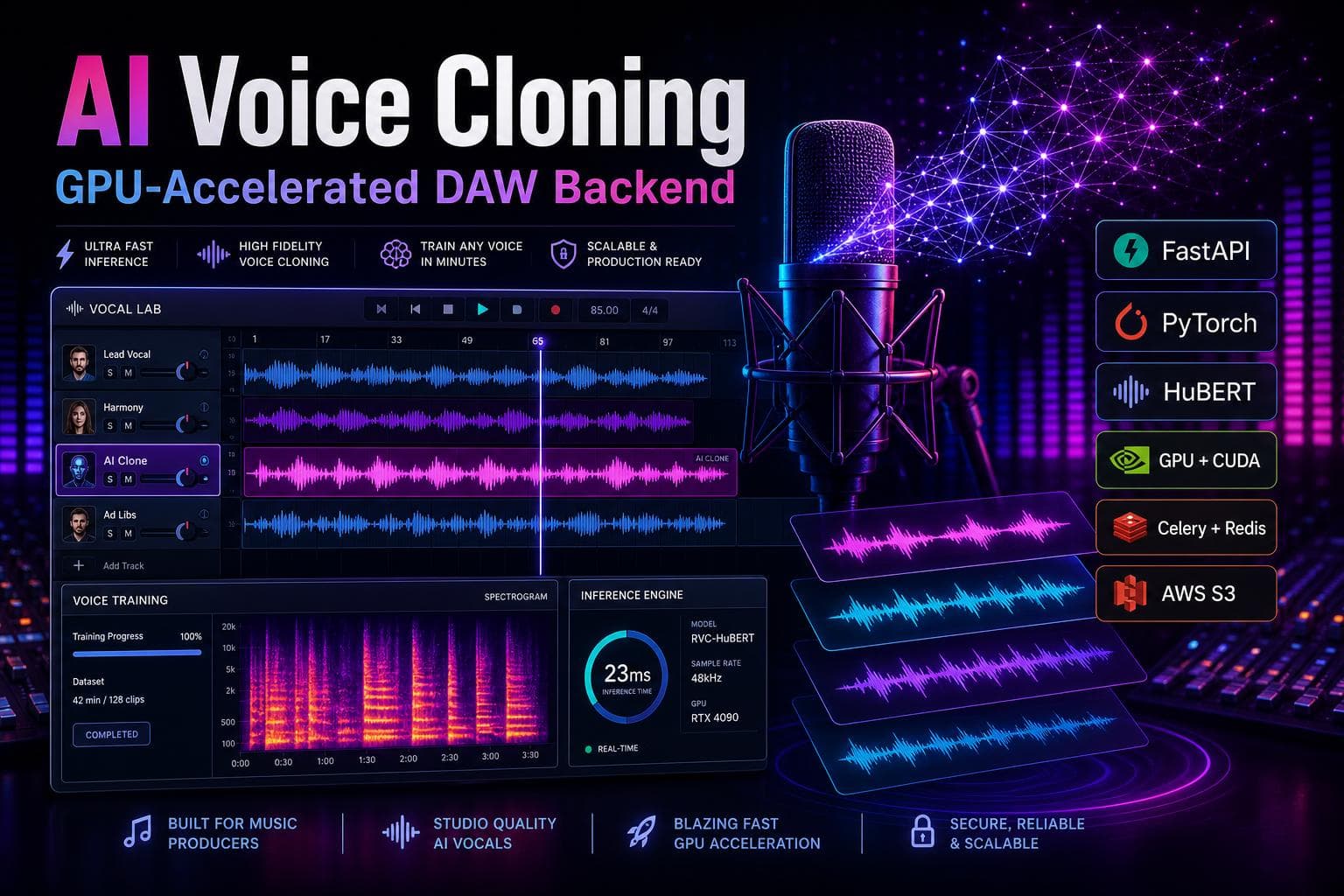
We built a modular, GPU-accelerated backend using Retrieval-based Voice Conversion (RVC) architecture, which separates linguistic content from vocal identity. During training, the platform extracts speaker-independent content features and pitch contours from a few minutes of uploaded vocal samples, learning the unique timbre of the target voice. Real-time HuBERT inference, FAISS-indexed voice embeddings on S3, and Celery/Redis-based queue management keep the DAW interface responsive while GPU workers handle training and inference asynchronously.
Key Capabilities
Tech Stack
The Result
Inference Latency: 30s Clip
“Our studio needed voice synthesis that sounded like the artist, not a robot. The team built a full DAW backend with real-time HuBERT inference, queue management via Celery and Redis, and FAISS-indexed voice embeddings on S3. Latency under two seconds for a 30-second clip. We have shipped two commercial releases on top of it.”
Have a similar system in mind?
Start a Discovery Session →More Case Studies